
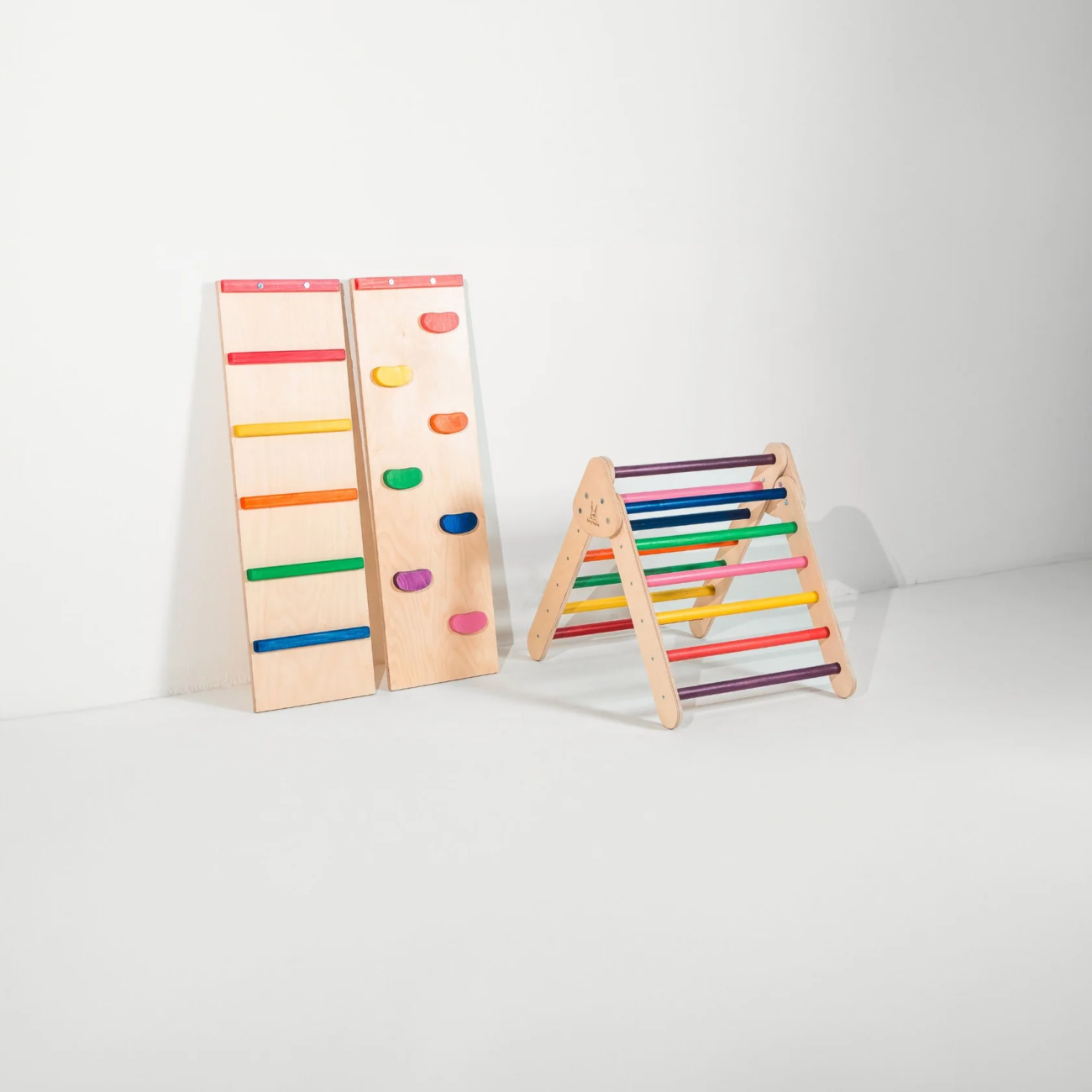
I’ll never forget the morning my daughter turned our living room couch into her personal Mount Everest. At 18 months, she was determined to reach the top, no matter how many times I gently redirected her to safer ground. Sound familiar?
That afternoon, exhausted from playing human safety net, I stumbled down a rabbit hole of parenting forums. One phrase kept appearing: Pikler triangle. Parents were raving about this wooden climbing structure that somehow transformed their little daredevils into confident, capable climbers, all while giving parents peace of mind.
Three months later, watching my daughter confidently scale her Pikler triangle (yes, we gave in), I understood the hype. But here’s what those Pinterest-perfect photos don’t tell you: not all Pikler triangles are created equal, and choosing the wrong one can mean wasted money and a frustrated toddler.
Let me share everything I wish I’d known before buying ours.
What Exactly Is a Pikler Triangle?
Picture a sturdy wooden A-frame structure with evenly spaced rungs, like a ladder folded into a triangle. Simple? Yes. Life-changing for active toddlers? Absolutely.
But the Pikler triangle isn’t just another trendy toy cluttering your Instagram feed. It was created nearly 100 years ago by Dr. Emmi Pikler, a Hungarian pediatrician who revolutionized how we think about child development. Her radical idea? Children should be free to move and explore at their own pace, without constant adult interference.
Dr. Pikler observed that children who had the freedom to climb, run, and explore naturally were not only healthier but also had fewer injuries. Why? Because they developed genuine body awareness and learned to assess risks on their own terms. The triangle became her signature tool for fostering this independent movement.
Today, Montessori families have embraced Pikler triangles, though Dr. Pikler wasn’t affiliated with Maria Montessori. They just shared similar philosophies about child-led learning. The structure typically includes the main triangle climbing frame with rungs spaced about three to four inches apart. Many sets also come with a reversible ramp or slide, smooth on one side for sliding and textured with rungs or climbing holds on the other. Some families add a curved arch rocker that doubles as a climbing bridge or tunnel, along with optional nets, cushions, and balance boards.
What makes these pieces magical is their open-ended nature. There’s no “right” way to play. Your child might use the triangle as a fort one day, a mountain to conquer the next, and a cozy reading nook by Friday.
Why Your Child Actually Needs a Pikler Triangle (Beyond the Instagram Appeal)
When I first told my husband we needed a Pikler triangle, his response was immediate: “We have a perfectly good playground five minutes away.” Fair point. But here’s what changed his mind and what these wooden wonders actually do for developing bodies and minds.
The Physical Development Powerhouse
According to parenting educator Laura Linn Knight, climbing is a natural instinct for toddlers. When babies and toddlers climb, they’re improving their gross motor skills while mimicking the actions they see adults doing. The Pikler triangle provides different benefits depending on where your child is developmentally.
For babies between six and twelve months, the triangle offers a sturdy surface to practice pulling up to stand and support for cruising along the base. It provides visual stimulation and goal-setting as they reach for the next rung. Toddlers from one to three years old develop balance and coordination with every climb while building core strength. They gain spatial awareness as they navigate up and over the structure.
Preschoolers from three to six years work on advanced motor planning, figuring out exactly how to get where they want to go. They practice risk assessment, learning to gauge whether something is too high or if they can make a particular move. Most importantly, they build genuine confidence in their physical abilities.
My daughter’s physical therapist actually recommended our Pikler triangle when we were working on her core strength. Within weeks, I noticed her balance improving, not just on the triangle, but everywhere: navigating stairs, walking on uneven surfaces, even her posture while sitting.
The Mental and Emotional Benefits
Here’s what surprised me most: the Pikler triangle isn’t just a physical toy. It’s a confidence-building tool that works on multiple levels simultaneously.
Every time your child successfully climbs higher than before, their brain lights up with achievement. They learn problem-solving as they figure out how to get their leg over the top. They develop persistence when they couldn’t do something yesterday but decide to try again today. Body awareness grows as they realize their foot fits in one spot but their hand needs to go somewhere else. And perhaps most valuably, they discover independence, understanding that they can accomplish difficult things by themselves.
Research shows that the global Pikler Triangle market reached approximately $153.2 million in 2024, reflecting a massive shift toward parents investing in tools that genuinely support child development rather than just entertaining them for a few minutes.
The Practical Parent Perks
Let’s be honest: these things aren’t cheap. But here’s the real-world payoff that makes them worth considering.
When it’s too cold, wet, or hot to play outside, the Pikler triangle becomes an indoor gym. No more bouncing-off-the-walls toddlers destroying your sanity on rainy afternoons. In an age where iPads are everywhere, finding toys that hold a child’s attention for more than 10 minutes feels like striking gold. The Pikler triangle routinely occupies kids for 30 to 60 minutes of independent play, giving you actual time to work, cook, or just breathe.
Unlike most baby toys that work for a narrow age range, Pikler triangles accommodate multiple children at once. Your one-year-old can pull up on it while your five-year-old creates elaborate climbing courses overhead. Quality Pikler triangles are built to last, with many parents reporting their children using them until age seven or eight, then passing them down to younger siblings or friends. That’s six to eight years of daily use from one toy, practically unheard of in the toy world.
One parent, Francisco, reviewed his Piccalio triangle after two years with a simple observation: “After 2 years, there has only been one toy that my kids have used every day.” That kind of lasting engagement justifies the initial investment for many families.
What Age Is Right for a Pikler Triangle?
This is the question I obsessed over before buying ours. Was my daughter too young? Would she outgrow it too quickly? Would we use it enough to justify the cost?
The official answer from manufacturers and child development experts is that Pikler triangles work for children from six months to six or eight years old. But the real answer depends entirely on your child’s individual development and the specific triangle’s size.
Understanding Age and Development
Between six and twelve months, your baby can’t actually climb yet, but they absolutely can use the triangle productively. They’ll practice pulling to stand using the rungs, develop grip strength by holding on, play underneath it (many babies love the cozy fort feeling), and build visual tracking skills by watching older siblings play above them. I recommend placing interesting toys on the first rung to encourage reaching and pulling up during this phase.
From twelve to twenty-four months comes peak Pikler triangle time. Your toddler will begin climbing the first few rungs tentatively, then develop the confidence to go higher over weeks and months. They’ll start understanding how to climb back down, which is often significantly harder than going up. During this period, they experiment constantly with different ways to use the structure, testing its possibilities.
Between two and four years old arrive the adventure years. Your child will master climbing to the top and learn to swing their leg over the peak with increasing confidence. They’ll eagerly add accessories like ramps and arches for variety and create imaginative scenarios. Suddenly the triangle becomes a castle, a spaceship, a mountain, a house, whatever their imagination conjures.
From four to eight years, children with larger triangles continue finding new uses. They incorporate the triangle into elaborate obstacle courses, weave it into complex pretend play narratives, practice more advanced movements like climbing while carrying objects or hanging from rungs, and use it as a quiet reading nook or fort when they need alone time.
Size Matters More Than You Think
Here’s a mistake I almost made: buying a “mini” triangle for my 18-month-old, thinking she’d “grow into” something bigger later. I’m so glad I researched more before pulling the trigger.
Most Pikler triangles range from 24 to 32 inches tall at their peak. That eight-inch difference dramatically affects how long your child will find the triangle engaging. Smaller triangles around 24 to 26 inches work perfectly for younger toddlers but may become boring by age three. Medium triangles between 28 and 30 inches hit the sweet spot for most families with toddlers, offering enough challenge for years. Larger triangles from 31 to 32 inches better suit older toddlers and children, providing the longest useful life.
The newer generation of triangles often features adjustable heights, which honestly feels like a game-changer. You can start low for a cautious one-year-old and raise it progressively as they gain confidence and ability.
Many parents report wishing they’d bought a taller triangle from the start. As one mother noted about her Piccalio triangle: “I purposely bought one that was slightly taller but not too tall so that both kids could enjoy it,” referring to her 18-month-old and four-year-old children who both actively used the same structure.
Our Top 3 Pikler Triangle Picks for 2025
After extensive research, testing feedback from real parents, and analyzing the 2025 market, these three Pikler triangles stand out. Each excels in different categories, so your “best” choice depends on your family’s specific needs and priorities.
Best Overall: Bunny Hopkins Climbing Triangle Set
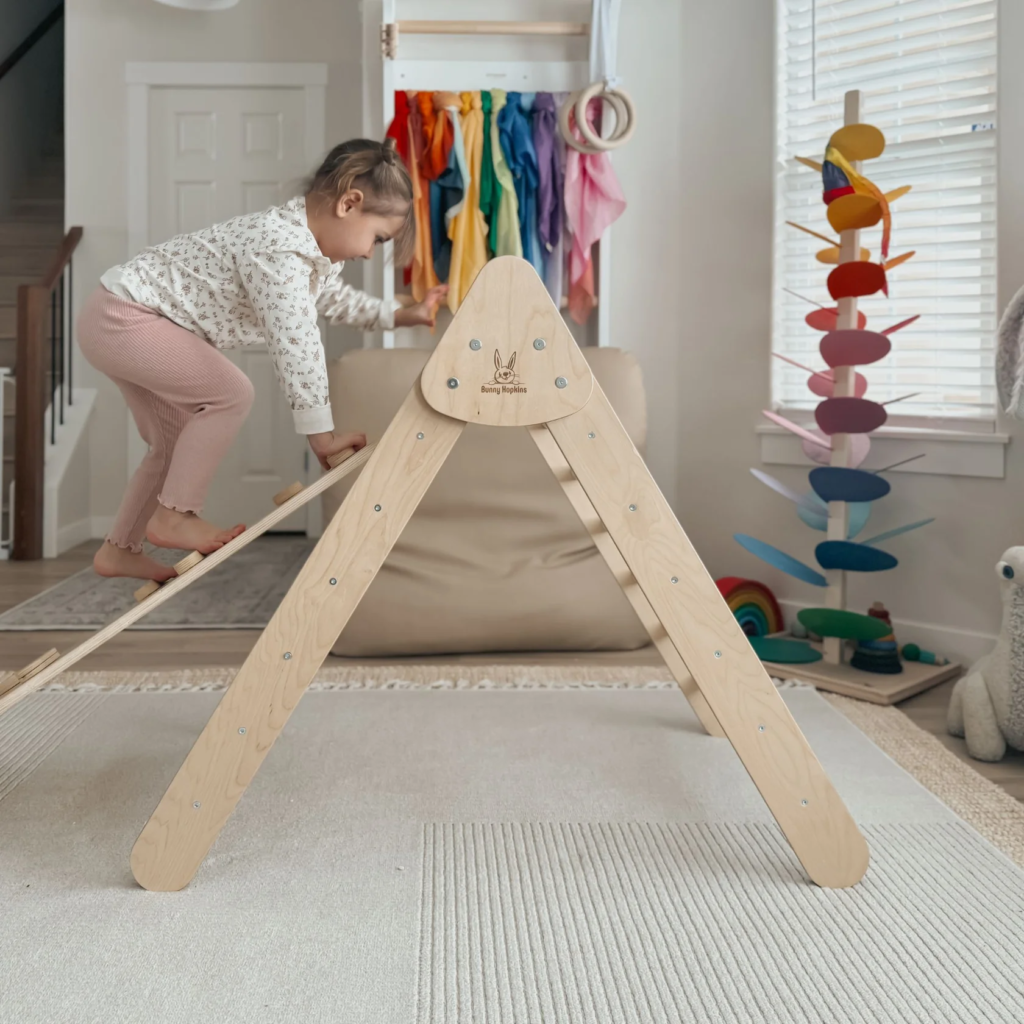
If I could only recommend one Pikler triangle to families, this would be it. Made in the USA with premium materials, the Bunny Hopkins triangle stands 30 inches tall, making it perfect for ages one through seven. It supports up to 350 pounds, meaning even adults can safely test it or play alongside their children. The optional reversible rock wall and slide attachment adds versatility, while the compact folding design makes storage manageable in smaller spaces.
The Bump’s 2025 testing rated it best for quality, durability, and overall value. Product tester McKenna scored it a perfect 10 out of 10 and assembled it in just one hour using only a Phillips head screwdriver. Parents consistently praise the sturdy construction and note their children use it daily for years without any signs of wear.
The catch? It’s may go some Dollars above budget . But considering the 350-pound weight capacity and quality craftsmanship, many families find it lasts through multiple children, making the per-child cost quite reasonable. This triangle works best for families who want the absolute best quality and plan to use it for multiple children or many years.
Best Value and Features: Wood and Hearts Triangle Set
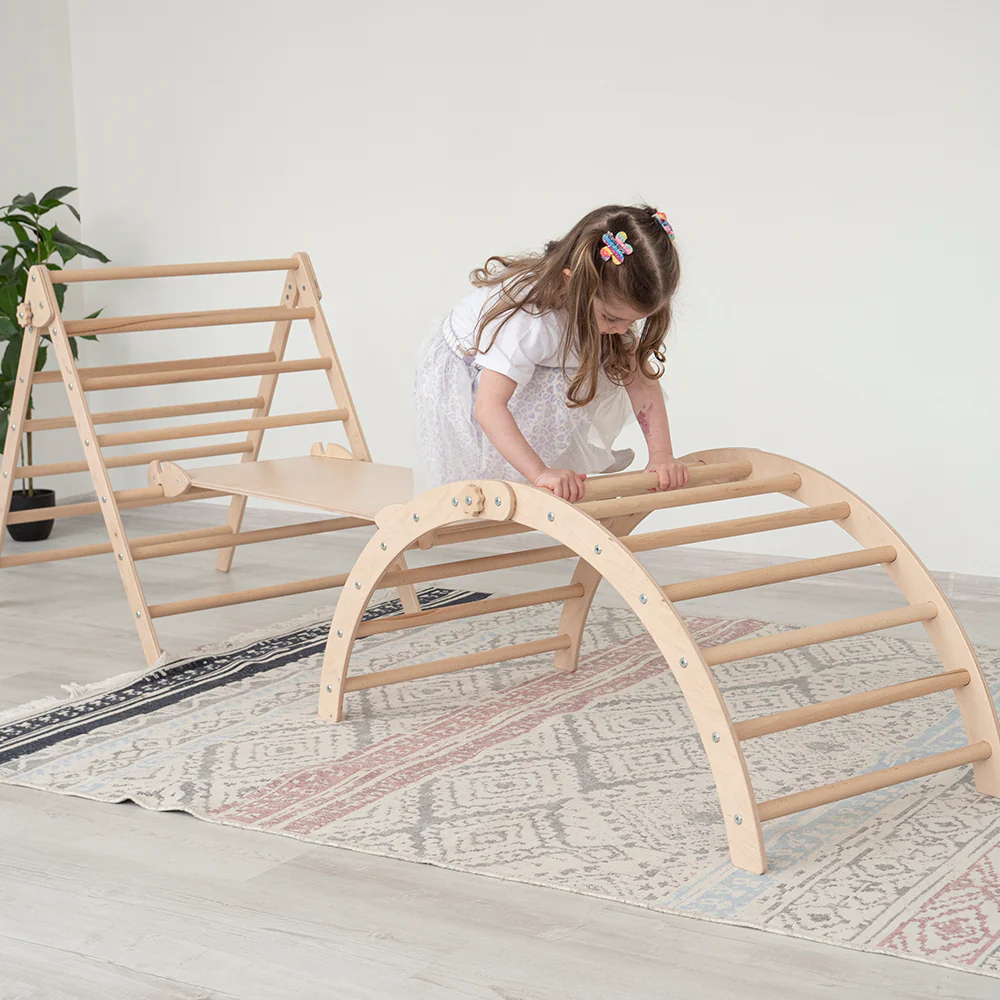
This set includes the triangle, arch, and dual-sided ramp, offering incredible value for the price point. Made from FSC-certified birch plywood sourced sustainably, it uses water-based, eco-friendly finishes safe for children. The company tests their products for weights up to 200 pounds and backs them with a two-year warranty. You can choose natural wood or colorful options to match your home aesthetic.
Product tester Veniece rated it 10 out of 10 for durability, noting it felt “really stable and secure” with her three-year-old and seven-year-old playing together simultaneously. She expects to pass it down when her youngest outgrows it, the ultimate endorsement from a parent.
The main consideration is that it’s made to order in Ukraine, so shipping takes one to nine business days for production plus eight to eighteen business days to ship. You’ll need to plan ahead, especially before holidays or birthdays. This set works perfectly for eco-conscious families who want a complete climbing system with excellent quality at a mid-range price point.
Best for Modern Minimalists: Piccalio Mini Climber Pikler Triangle Set
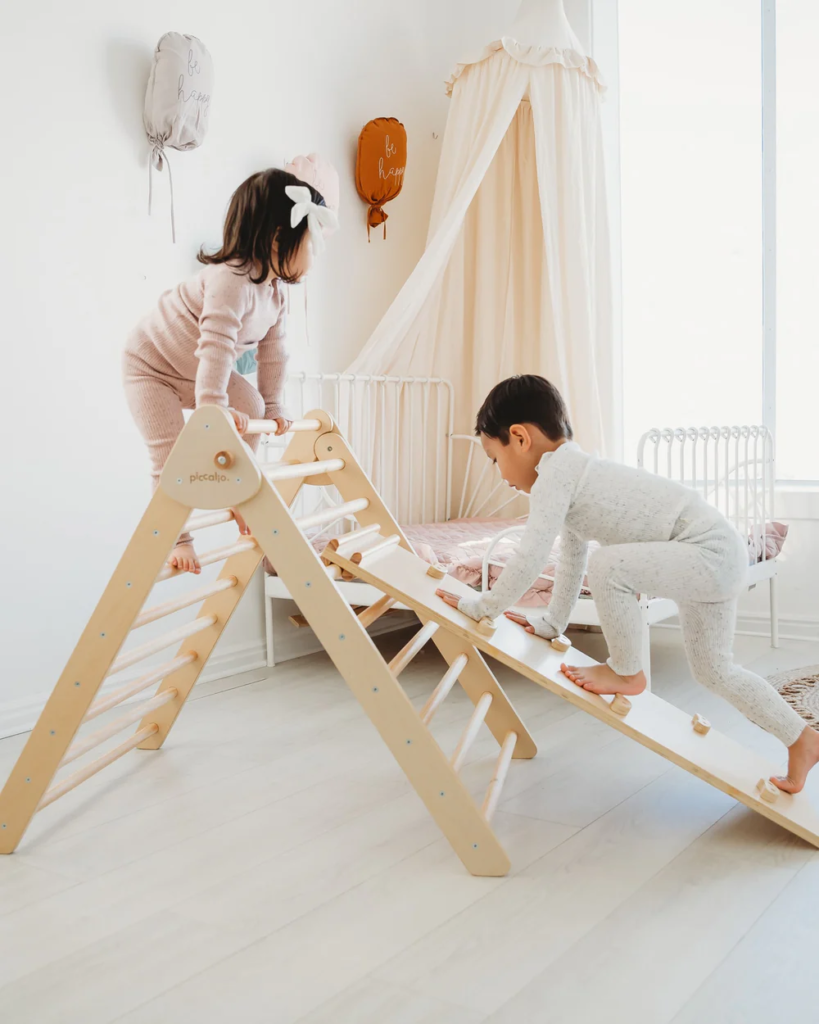
The foldable design works perfectly for small spaces or families who want the option to put the triangle away when not in use. Standing 30.5 inches tall, it hits the ideal height for toddlers through early elementary ages. Made from FSC-certified birch plywood and New Zealand pine, it’s Greenguard Gold Certified, meaning it has the lowest possible chemical emissions. The structure holds up to 132 pounds comfortably.
The reversible ramp offers a slide on one side and rock climbing holds on the other, though parents note the climbing side works better with socks or shoes since the holds can feel uncomfortable on bare feet. With nearly 200 five-star reviews, Piccalio has built a loyal following among design-conscious parents.
Francisco’s review after two years captures the lasting appeal: “After 2 years, there has only been one toy that my kids have used every day.” Another parent, Diana, notes: “This is our third product from Piccalio and the brand never disappoints! The Pikler is iconic and this one in particular is clearly very well made.”
This triangle suits urban families with limited space who want a beautiful, high-quality piece that folds away easily without compromising on safety or durability.
How to Choose the Perfect Pikler Triangle for Your Family
Still feeling overwhelmed by options? Let me walk you through the decision-making process based on what actually matters in daily use.
Consider Your Space Honestly
If you live in a small apartment or have limited play space, look for foldable designs like Piccalio or many Wood and Hearts models. Before buying anything, measure your floor space carefully. Open dimensions typically span 30 to 36 inches wide and 36 to 40 inches deep, which sounds small but takes up real space in a living room. The good news? Folded dimensions shrink dramatically, often to just six inches deep, allowing you to tuck the triangle against a wall when needed.
Families with dedicated playrooms have more flexibility. You can consider larger sets with multiple pieces and think about future additions like arches, balance boards, and climbing nets. Non-foldable options often cost less and offer slightly more stability since they don’t need folding mechanisms.
Think About Your Specific Child
Every child approaches climbing differently, and matching the triangle to your child’s temperament matters more than you’d think.
Cautious climbers benefit from starting with a smaller or adjustable-height triangle. Lower heights feel less intimidating when they’re just beginning, helping build confidence gradually. Consider models with closer rung spacing around 3.5 inches instead of four inches, giving smaller hands and feet more options.
Fearless adventurers need different considerations. Go taller from the start, around 30 to 32 inches, to provide enough challenge that they won’t immediately feel they’ve mastered it. Look for sets with multiple accessories for variety, keeping their interest longer. Ensure higher weight capacity for longevity, since confident climbers often want to try more complex movements.
Families with multiple children need triangles that allow simultaneous play without feeling cramped. Larger triangles accommodate more than one child safely, and higher weight ratings matter when two or three kids climb together. Durability becomes absolutely critical since the triangle will see much heavier use.
Safety Checklist You Cannot Skip
Before purchasing any Pikler triangle, regardless of price or brand, verify these safety essentials personally.
Rung spacing should measure between three and four inches apart. Spacing too wide creates an entrapment risk for little bodies, while spacing too close makes climbing unnecessarily difficult. Weight capacity should be at minimum 130 pounds, though 200 pounds or higher is ideal for longevity and safety margin. Look for certifications including ASTM F963, CPC, and CPSC compliance, which verify the product meets safety standards.
Materials matter significantly for both safety and longevity. Seek FSC-certified wood, water-based finishes, and zero VOC (volatile organic compound) emissions. Stability comes from either locking mechanisms or a sturdy base design that won’t tip even when children climb enthusiastically. Run your hands over every surface checking for smooth finishes with no splinters, sharp edges, or rough spots that could injure tender skin.
Budget Reality Check
Pikler triangles span a wide price range, and understanding what you get at each level helps make smart decisions.
Budget-friendly options under $200 exist, with brands like Goodevas offering triangles between $129 and $189. These work fine for some families but may sacrifice some quality or longevity. You might find yourself replacing them sooner than premium options.
The sweet spot for quality falls between $200 and $300. Brands like Wood and Hearts and Little Partners offer excellent balance between durability and price at this level. Most families find these provide years of reliable use without breaking the bank.
Premium options from $300 to $450 include Bunny Hopkins, Piccalio, and complete Wood and Hearts sets. These are built to genuinely last through multiple children with proper care, often looking and functioning like new even after years of daily use.
Here’s a helpful way to think about cost: calculate the price per year of expected use. A $400 triangle used daily for six years costs just $67 per year, significantly less than many plastic toys that break within months. When viewed through this lens, the premium options often represent better value than cheaper alternatives.
Real Talk: Is a Pikler Triangle Worth It?
After a year of daily use, here’s my honest assessment without the marketing spin.
The advantages genuinely impressed me. My daughter’s confidence and physical abilities have noticeably improved in ways I didn’t anticipate. She attempts new physical challenges everywhere now, not just on the triangle.That confidence even carried over into daily routines, which is why we later added a toddler tower to our kitchen , something I break down in my list of the [best toddler towers for everyday independence].
Anyways, the pikler triangle provides 30 to 60 minutes of independent play daily, which feels absolutely priceless for work-from-home parents trying to take Zoom calls. The play happens entirely screen-free, a rarity in 2025. The triangle works for a huge age range, with our five-year-old neighbor still playing on it enthusiastically when she visits. It’s beautiful enough to keep in the living room without feeling embarrassed when guests arrive. Most importantly, it actually gets used daily, unlike 90 percent of toys gathering dust in closets.
But there are genuine drawbacks to consider honestly. The significant upfront cost makes it a major purchase decision, not an impulse buy. It takes up floor space even when folded, though less than you’d think. Young climbers require supervision, especially during the first few months of use. Assembly can take one to two hours depending on your mechanical skills and the specific model. And fair warning: it may increase your child’s desire to climb everything in your house, including the couch, counters, and occasionally you.
So what’s my verdict after living with one? If you have an active, climbing-obsessed child and the space and budget for it, a quality Pikler triangle is absolutely worth the investment. It’s one of the few “toys” that genuinely supports development while providing years of engagement rather than weeks.
However, if your child shows no particular interest in climbing, you live in a tiny space, or you have easy access to excellent playgrounds you visit daily, you might consider waiting or choosing a smaller, less expensive option first to test whether your child enjoys this type of play.
Final Thoughts: More Than Just a Triangle
Here’s what I didn’t expect about our Pikler triangle: the way my daughter’s face lights up when she accomplishes something new. Last week, she figured out how to hang upside down from one of the rungs. She must have done it fifty times in a row, giggling each time, so intensely proud of her new skill. Watching that joy, that pure sense of accomplishment, made every dollar and every inch of floor space worth it.
That’s the real magic of the Pikler triangle. It’s not about having the trendiest playroom or the perfect Instagram photo, though they do photograph beautifully if we’re being honest. It’s about giving your child a tool to discover what their body can do on their own terms, at their own pace, without an adult directing every move.
Dr. Emmi Pikler believed children should have the freedom to move naturally, learning their own physical limits through experience rather than constant intervention. A century later, in our overscheduled, over-assisted world where we hover over every move our children make, that philosophy feels more relevant and radical than ever. The Pikler triangle isn’t just a climbing toy. It’s a vote of confidence in your child’s innate abilities and wisdom.
So whether you choose the premium Bunny Hopkins, the sustainable Wood and Hearts, the sleek Piccalio, or any other quality option, you’re not just buying a toy to occupy your child for a few months. You’re investing in your child’s physical development, their growing confidence, and those priceless moments of independent discovery when they figure something out entirely on their own.
And trust me on this: the first time you watch your little climber reach the top and look back at you with that expression of pure triumph, eyes sparkling with the knowledge that they did it themselves? It’s worth every single penny, every inch of floor space, every moment spent researching the perfect one.
Ready to transform your playroom? Remember to start with your child’s current abilities and your space constraints, prioritize safety certifications above all else, and choose quality over trends. Your future self, watching your confident, capable climber tackle new challenges, will thank you for making the investment.
Have questions about Pikler triangles or wondering which one might work best for your specific situation? Drop them in the comments below. I’d love to help you find the perfect fit for your family.
